
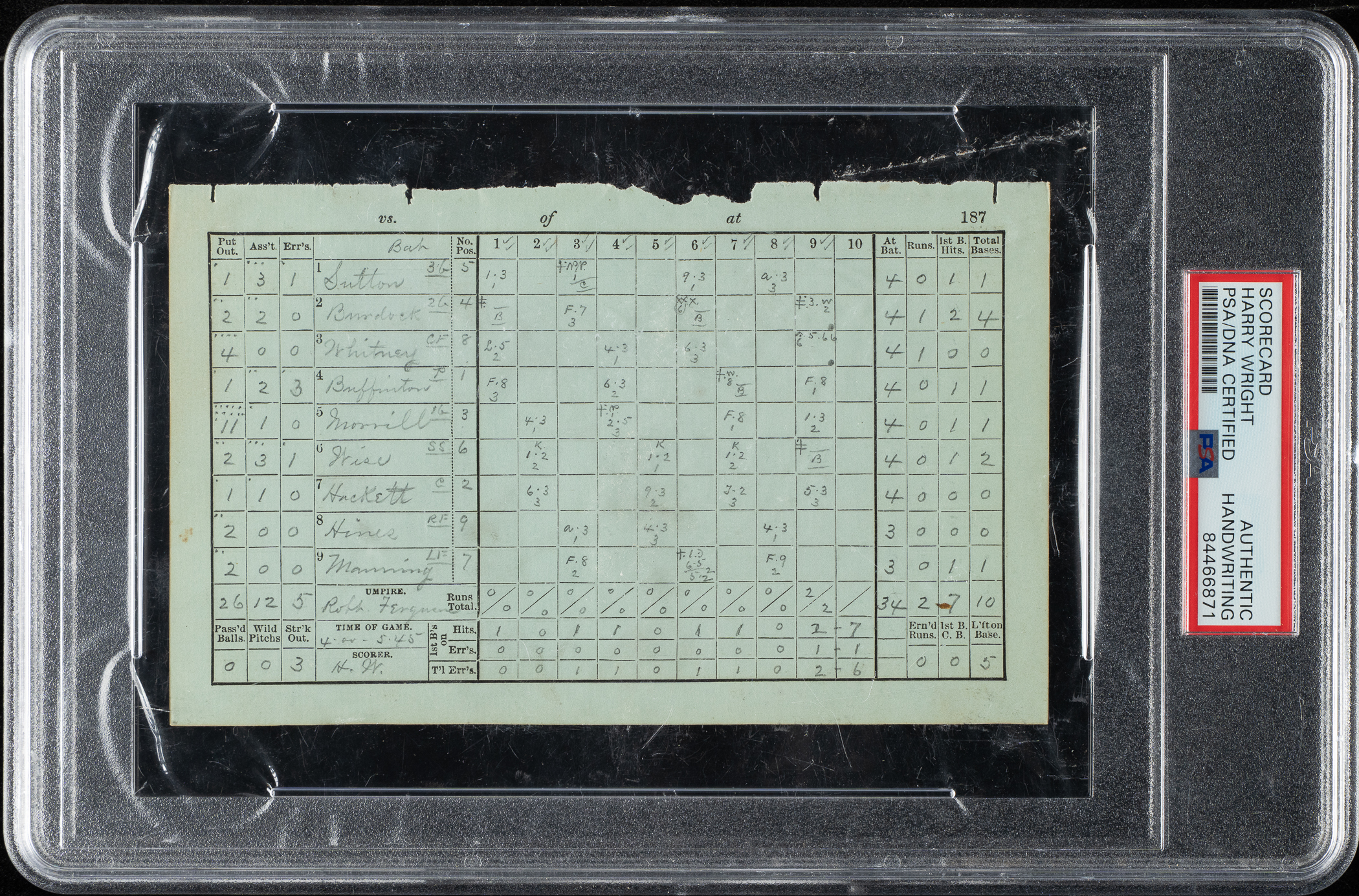
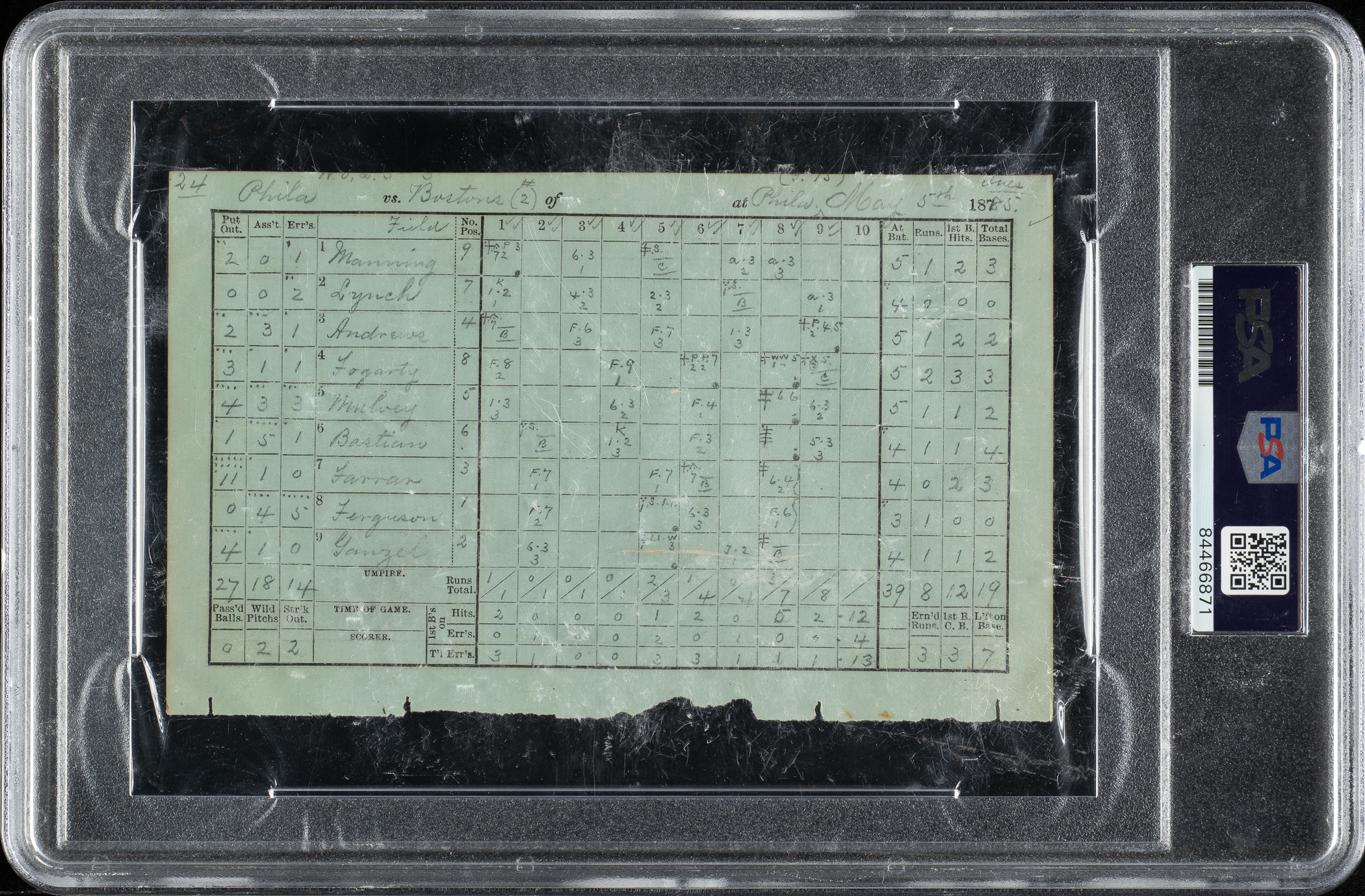
Lot # 3427: 1885 Harry Wright Handwritten Personal Scorebook Page- PSA/DNA
Info
This lot is closed. Bidding is not allowed.
Item was in Auction Fall 2026, which ran from Fri, Nov 20, 2026 12:00 PM to Sun, Dec 6, 2026 9:59 PM
Starting Bid:
$300
Bids:
(Bid History)
Current Bid
$
High Bidder
Out Bid
Total Bid Cost
| Next Bid | $ |
| Buyer's Premium | $ |
| Sales Tax (estimated) | $ |
| Shipping Fee (estimated) | $ |
| Total Cost | $ * |
* Shipping and sales tax calculations are 'best guess' estimates based on your current shipping address. Final calculations may vary at billing.
Description
Presented is a remarkable scorebook page scored in pencil by Philadelphia Quakers manager Harry Wright. This scoring page was removed from one of Wright's personal scorebooks. The double-sided page is a partial scoring of two different games. The one side documents a game played on May 4, 1885, between the Quakers and Boston Beaneaters. The reverse chronicles a game the following day (May 5th) between the two clubs. In addition to having been scored in Wright's hand, the page also features Wright's initials "H. W." at the base of one side in the scorer's box. The piece is encapsulated and certified as "Authentic" by PSA/DNA. Considered one of the game's founding fathers, Wright ranks among the most influential baseball figures of the nineteenth century. In 1869, he founded and managed the Cincinnati Red Stockings, baseball's first all-professional team. Following his managerial career in Boston, where he won seven league titles over the course of eleven seasons, Wright enjoyed successful runs as manager of Providence and Philadelphia before retiring in 1893. He is credited with developing several important innovations still in use today, including the use of hand signals to his players, the constant repositioning of fielders in response to batters' tendencies, pre-game batting and fielding practice, and the use of statistics with regard to managerial strategy. The importance he placed on statistics is evidenced by this scorebook page, in which he meticulously kept track of every play of the game. The teams' lineups are noted along with the date, location, and length of the game. The data on this scorebook page, and others like it, are a treasure trove of information for baseball scholars. The results of games from this time period are well documented, but box scores are not. The scorebook page (6.5 x 4 inches) is in Excellent condition, with only a few inconsequential spots along the edge where removal from a larger scorebook is evident. This is an exceptional relic of one of the game's founding fathers, which would be at home in even the most advanced collection.
Loading...
You Might Also Like
Suggestions of other lots in this auction
Suggestions of other items in the marketplace

Buy Now – $1,100

Buy Now – $250

Buy Now – $250

Buy Now – $1,100

Buy Now – $500

Buy Now – $450

MP# 6074
Buy Now – $300
