Lot # 2547: 1956 Topps Willie Mays Bill Forsyth Baseball Card Painting (1978)
Info
This lot is closed. Bidding is not allowed.
Item was in Auction Summer 2026, which ran from Tue, Jul 28, 2026 11:59 AM to Sun, Aug 16, 2026 9:59 PM
Starting Bid:
$1,000
Bids:
(Bid History)
Current Bid
$
High Bidder
Out Bid
Total Bid Cost
| Next Bid | $ |
| Buyer's Premium | $ |
| Sales Tax (estimated) | $ |
| Shipping Fee (estimated) | $ |
| Total Cost | $ * |
* Shipping and sales tax calculations are 'best guess' estimates based on your current shipping address. Final calculations may vary at billing.
Description
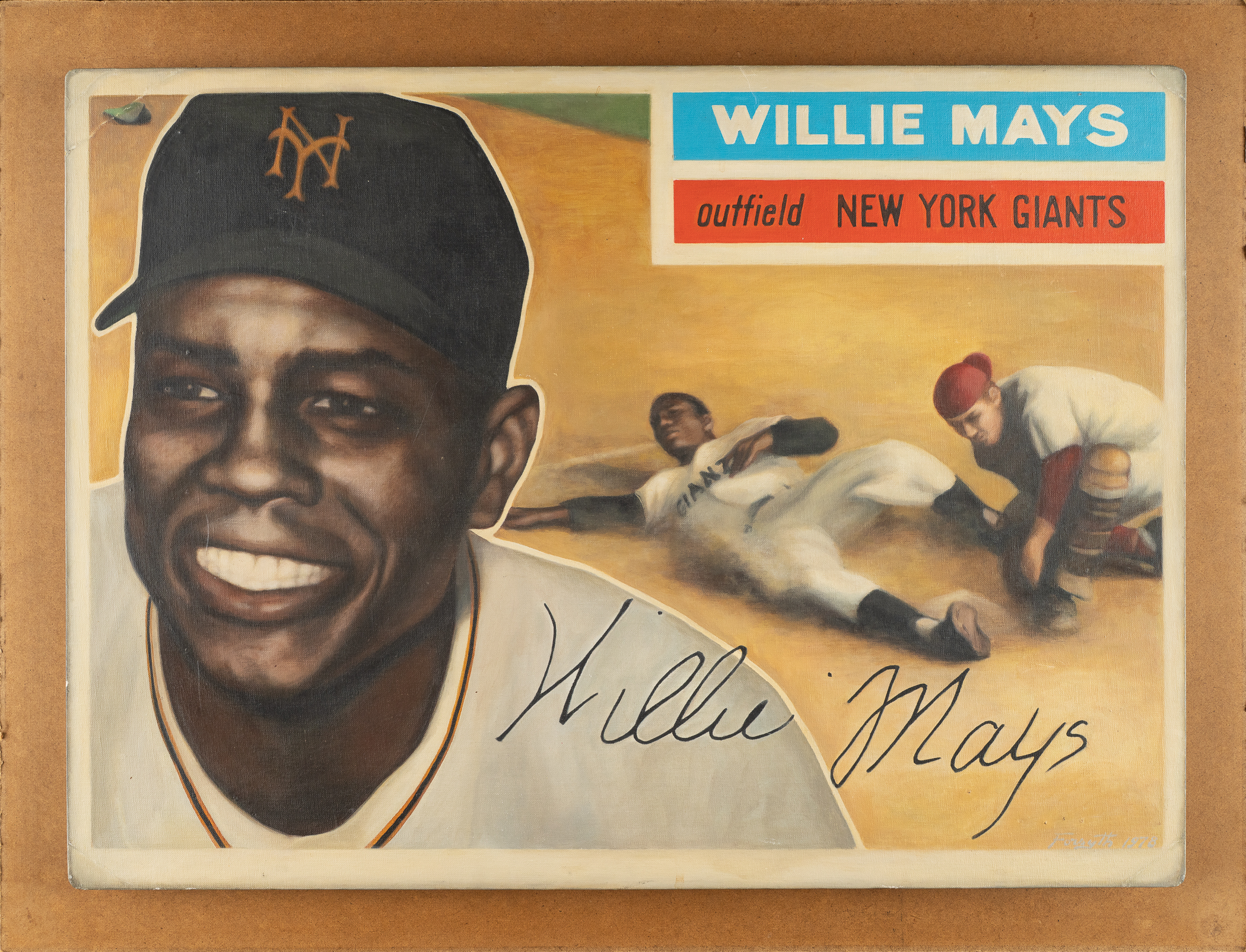
"A perfectly gorgeous card in every way. The cap lying on the base path, in upper left corner, was my addition. After all, Willie was known for losing his cap, most often between third base and home plate." - Bill Forsyth, 1979.
Original acrylic on canvas board painting (30 x 22 inches) of Willie Mays' 1956 Topps baseball card by artist Bill Forsyth. Signed and dated ("1978") by the artist in the lower right corner. Mounted on wood frame backing to total dimensions of 34 x 26 inches.
The baseball card paintings of artist Bill Forsyth were a sensation in the 1970s. Possessed with a spirit of nostalgia, but in the tradition of American Pop Art, Forsyth painted images of old baseball cards in a huge, larger-than-life format. His works drew attention to baseball cards, and for the first time ever, presented these relics of childhood as a higher art form. This was a time when baseball cards as a hobby were just beginning to receive attention from the press as an area of serious collector interest by adults.
The nostalgia craze in America was in its infancy. Newspaper articles were beginning to document the growing adult collector interest, drawing attention to the increasing monetary values that seemed to give the field respect. Conventions were still a novelty and received extensive press coverage every time a show opened its doors. It was against this backdrop in the mid-1970s that artist Bill Forsyth began to have gallery showings featuring his paintings of images of old baseball cards in a huge, larger-than-life format. His paintings were unlike anything ever seen before, drawing tremendous attention from the art world, the media, and the public. In addition to generating national attention at formal art gallery showings in New York City, which were covered by such prestigious papers as The New York Times, Forsyth’s baseball-card paintings were chosen for display by the Smithsonian Institute at its 1981 “Champions of Sport” art exhibit. Examples were also displayed at the National Portrait Gallery in Washington, the American Museum of Natural History in New York, the Chicago Historical Society, and the Hall of Fame in Cooperstown, among other highly respected museum venues. Never before had baseball cards in any form, however deserving in the eyes of collectors, been recognized as art by the media or the public, let alone by the established art world.
In part, it was their scale. They were giant, each measuring about 2 x 3 feet, and on thick canvas board. It was also, in part, that the cards were “beat up,” painstakingly created with creases, and with even the actual corners of the canvases rounded, which gave them a profound realism that struck a chord. And, in part, it was their execution. They were perfect. Anyone familiar with the images was awestruck. The art shows were an outrageous spectacle, showcasing rows of giant baseball cards on huge canvases for sale at prices that started at $800 at first. As demand exceeded Forsyth’s abilities to produce more canvases, the price rose to $2,000 per painting. To put things into perspective, a T206 Wagner was at this time worth just several thousand dollars. Forsyth could have sold many more paintings, if it had been possible to produce them, but his process required between 18 and 24 solid working days per painting. Because of this, in the early 1980s, he stopped painting baseball cards altogether. In the end, as incredible as it sounds, especially for all the attention they received, his entire series of baseball card paintings numbered only 76.
In 2005, Robert Edward Auctions presented a spectacular collection of 15 of Forsyth's baseball card paintings in its Spring auction, including the offered piece. As a testament to their popularity, the 15 paintings sold in 2005 were the only examples to ever resurface. An additional 16th painting featuring Duke Snider's 1955 Topps card, was offered in REA's Summer 2019 auction. The size/weight of this item requires that there will be an additional shipping charge for this lot.
Loading...
You Might Also Like
Suggestions of other lots in this auction
Suggestions of other items in the marketplace

Buy Now – $700

Buy Now – $800
MP# 3948
1955 Jackie Robinson and Yogi Berra International News Service Photograph - PSA/DNA Type III
Buy Now – $900
MP# 5920
1948 Jackie Robinson with Andy Pafko Original International News Service Photograph PSA/DNA Type I
Buy Now – $1,700
Buy Now – $650

Buy Now – $3,250
MP# 3526
Buy Now – $90
